
the same room, two worlds
The same room lights up differently for each of us. The first move is noticing why.

Two people walk into the same cafe on a Tuesday afternoon. Same door, same counter, same smell of coffee and warm bread. They stand a few feet apart, looking at the same room.
For her, the menu board lights up. Coffee 3.25. Latte 4.25. Sandwich 6.75. The prices come forward as if someone turned up their brightness, and a small math starts running in the back of her mind before she has decided anything. She grew up at a kitchen table where money was counted out loud. The board is not asking her to add. She is adding anyway.
For him, a single empty chair lights up. It sits at a round table of friends who are leaning in, laughing at something, easy with each other. The chair is just a chair. To him it glows like a wound. He grew up at the edge of the playground, watching the game from outside the chalk line, and some old part of him still scans every room for the place where he does not belong.
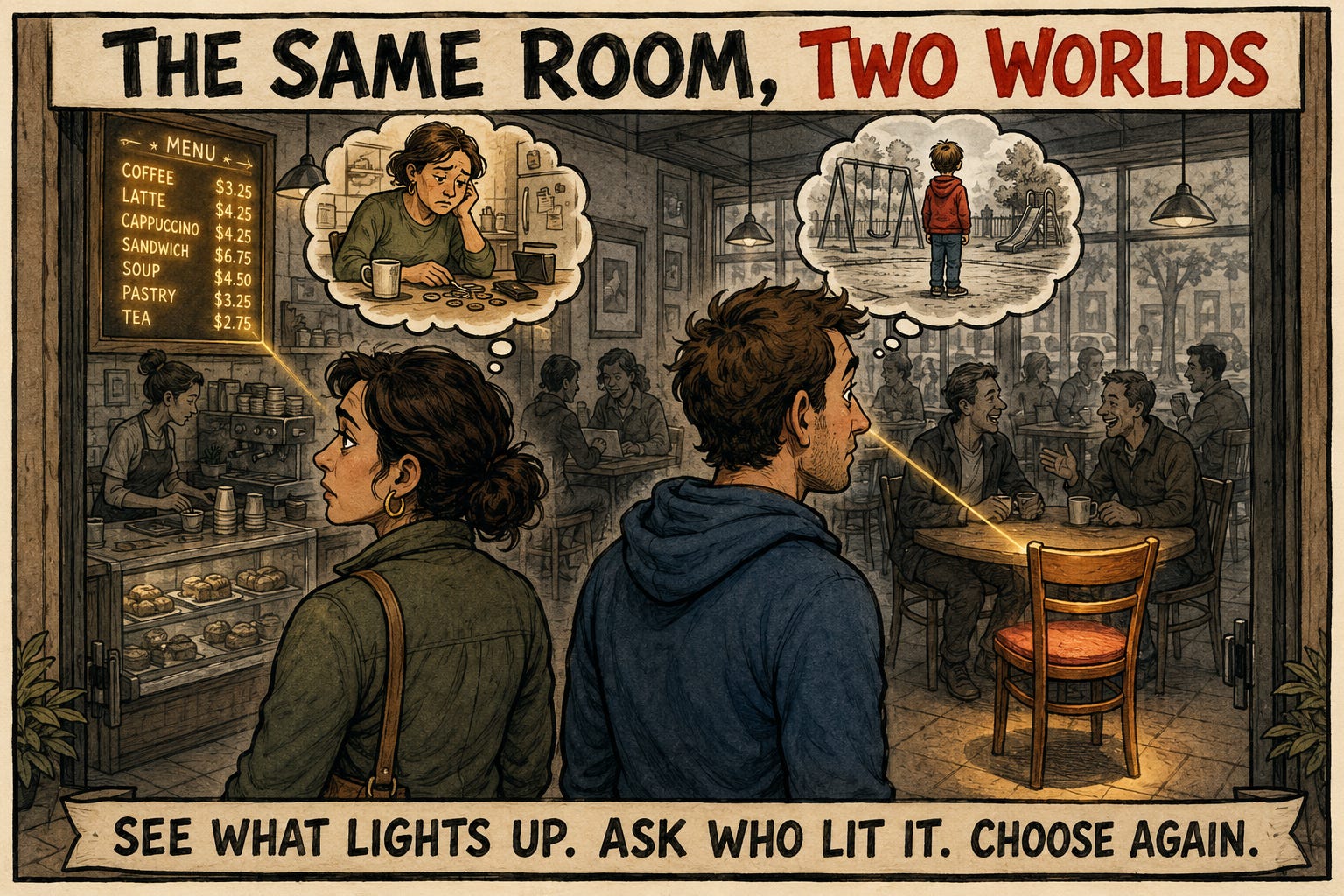
The rest of the cafe stays unnoticed. The art on the walls, the hiss of the machine, the dog tied up outside, the dozens of other things competing for notice. None of it reaches them. Two people, one room, two different worlds.
The room is neutral. The spotlight is not.
There is a word for the thing that decides what comes forward and what stays back. Salience. It is the moment the world tilts and one detail grabs you before you have chosen to care about it. You did not aim your attention at the prices, or at the chair. They reached up and took it. By the time “you” arrive, the selecting has already happened.
This runs ahead of your will. Before you decide anything, something has already decided what is worth deciding about. And it decides using your history. The woman’s attention was tuned years ago, at that kitchen table. The man’s was tuned at the edge of the playground. The tuning is invisible now. It feels like the room. It is not the room.
For a while now I have been mapping the stages a single experience moves through, from the first faint stir to the thing you actually do. I call it the Enactment Arc. It runs like this: spanda, salience, desire, knowledge, will, action, integration. Spanda is an old word for the first pulse, the stir before anything has a shape. Salience is the next beat, where what stirs gathers into a figure, where one thing steps out of the background and says look here.
Notice how early that is. Salience comes before desire, before you want anything. Before knowledge, before you have a story about it. Before will, before you choose. Long before action, before you say or do the thing.
Which means that if you miss salience, the whole arc runs on rails you did not lay. The grab sets the agenda. Desire forms around whatever already lit up. You build a story to justify the desire, you act on the story, and the whole time it feels like you. Like free choice. Like just how the world is. It was a groove worn into you long ago, running itself.
This is also the good news. Salience is early enough that the arc can still be intercepted. You cannot stop the grab. You can catch it. And catching it is most of the work.
Here is how. Three beats. You can use them today, in the next room you walk into.
One. See what lights up. Treat your own attention as information. When something jumps out at you, a price, a face, an empty chair, a phone screen, a flicker in someone’s tone, notice that it jumped. Do not yet ask whether it matters. Just catch the grab and name it. There it is. That lit up.
Two. Ask who lit it. The grab feels like simple seeing, and it never is. So ask the question that opens the floor under it. Why this, and why me. The woman, if she catches the math, can ask where she learned to count before she orders. The man, if he catches the chair, can ask who taught him to find the empty edge of every room. The grab points backward, toward the hand that tuned you. Follow it.
Three. Choose again. Once a grab is seen and sourced, a small gap opens between you and it. That gap is the whole prize. Inside it you are no longer in that groove. You can let the prices stay prices. You can let the chair be a chair, or go and pull it out and sit down. You decide, instead of react. Not because the conditioning is gone. Because for one moment you can see around it.
Most of us live our whole lives without ever questioning the spotlight. We argue about the room instead. He says the cafe is cold and unwelcoming. She says it is overpriced. They are each describing their own lighting and calling it the world, and they are each, quietly, right about themselves and wrong about the room.
So the next time something reaches up and grabs you, before you do anything with it, try the one small move. Ask who is holding the light.
You will be surprised how often it is a much younger version of you. Still counting coins at the kitchen table. Still standing at the edge of the playground, doing their best to keep you safe in a room that closed a long time ago.
That is one stage of the arc. There are others, before it and after, and I will walk them one at a time. For now, salience is enough to practice with.
I appreciate this post and identified with it. Looking forward to learning more.