
the weak link
An interlude in the walk through the Enactment Arc, and what a frozen tent taught me about resilience.

Up in Lapland, in the middle of my eleven months in the Finnish Army, we slept ten to a tent. The tent had a small heating unit, and the unit had to be fed wood through the night. We took turns. The turn was called kipinä, which means spark, a small thing that can grow into something greater. It was also our word for the man who stayed awake while nine slept, feeding the fire. The warmth of all ten ran through the one who was awake.
One night the man on kipinä fell asleep. Around 3am we woke at once, shivering, the fire dead, the cold already inside our bags. It gets cold fast up there. It’s not easy to relight the fire. Ten of us dropped into the same emergency by a single closed pair of eyes.
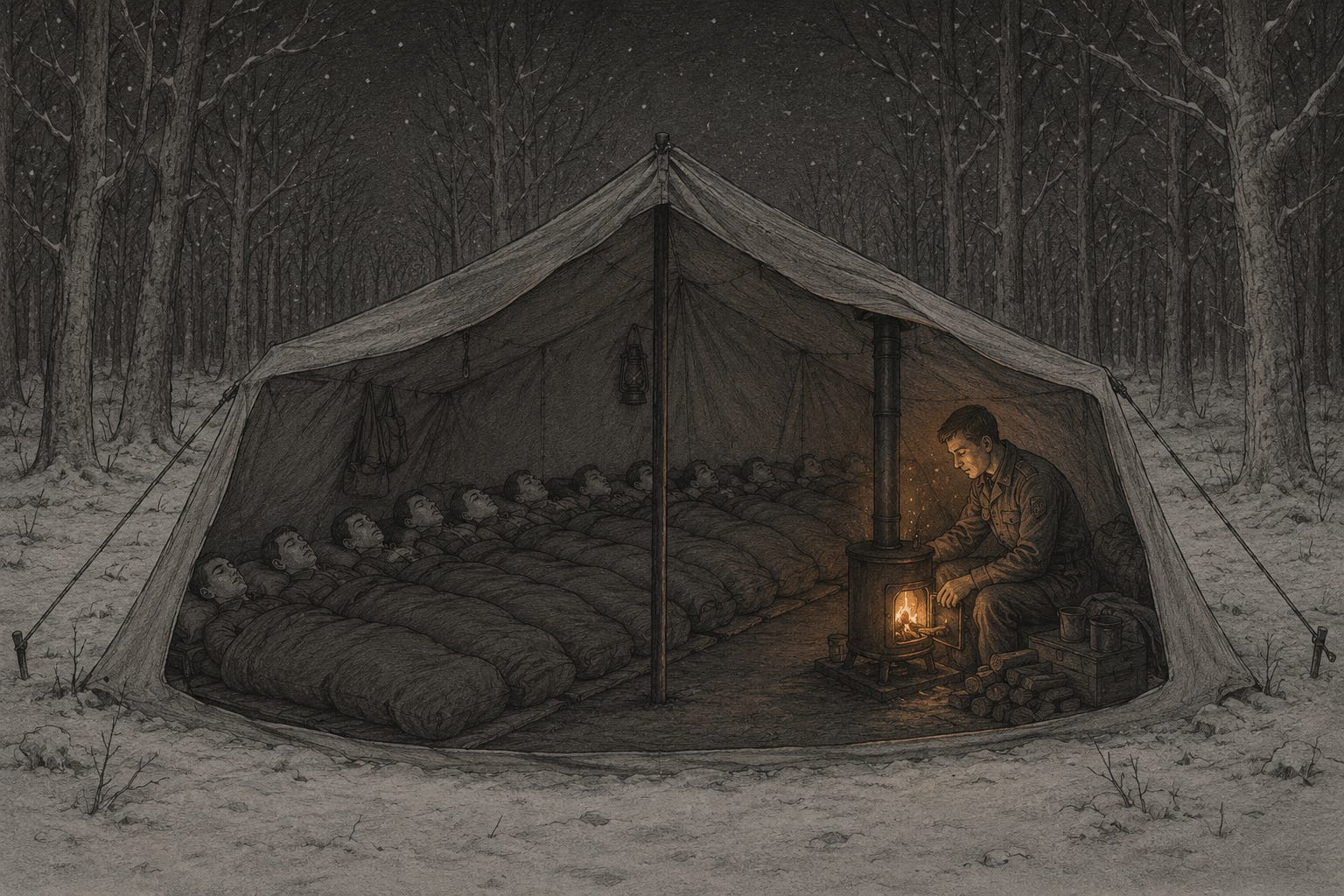
A system is only as strong as its weakest link.
That is not a slogan. It is a plain description of how the night went. The other nine could have been the strongest soldiers in the company. It did not matter. The chain of warmth ran through one unprotected point, and it broke where he slept.
The Finns have a word for what usually got us through: sisu, the grit to endure what seems impossible. Nine men full of sisu still woke up cold. The resilience of a system is a different thing from the courage of a person inside it.
I have been walking through what I call the Enactment Arc. It is my way of mapping how any action follows from a signal. I started this series with salience. Here, between stages, I want to talk about the chain itself.
First there is the stir.
Then something catches my attention.
Then desire forms.
Then I need knowledge.
Then will gathers.
Then action.
Then integration, where I learn from what happened and carry that learning into the next turn of the arc.
Put more simply: I notice, I want, I understand, I choose, I act, and I learn.
The reason I walk the arc slowly is simple.
Each stage is a link to the next. And a chain does not fail on average. It fails where it is thinnest.
I can have a will of iron and no clear sense of what matters, and my will may serve the first thing that grabs me. I can have desire and no knowledge, and move with great feeling toward the wrong thing. I can have knowledge and no will, and understand my life with painful clarity while changing nothing. I can act without integration, and next time begin from zero again, as if experience taught me nothing.
The arc does not break where I am strong. It breaks where I am thin.
That is why resilience is about capacity building. It is easy to admire the whole arc. It is harder, and more useful, to ask where the fire tends to go out.
In a family, the weak link might be the conversation everyone avoids. In a team, it might be the decision nobody owns. In an organization, it might be the vendor everyone quietly assumes will always be there. In a society, it might be the loss of any shared future worth wanting.
The weak link is rarely just a weak person. More often, it is the place where a system has placed too much load on one unprotected point.
This is where resilience becomes real.
Resilience is the capacity of a system to keep its arc intact under load. To still notice, still choose, still act, when the fire has gone out and everyone is cold.
A strategy that cannot survive its own weak link, or the loss of a vendor, is not a strategy. It is a hope. The plan that works only when nothing goes wrong is a plan for a world that does not exist. We build elaborate arcs, at every level, that quietly assume the man on kipinä stays awake.
He does not always stay awake.
In calm, the weak link hides. Under pressure, it is found. Stress is a diagnostic. Collapse is the same diagnostic with the volume turned all the way up. The things that come apart in a hard year were usually thin already. The weather only showed us where.
In the courses I teach, we sometimes give these pressures old names. I use those names because abstract pressures are easier to face when we can recognize how they show up. Moloch names the race to the bottom, where everyone competes their way into a future nobody wants. Wendigo names the hunger that grows by feeding. I do not mean literal demons. I mean loads. They find the thinnest stage of the arc and pull.
And yet.
The whole reason to map a chain is that a chain can be mended. A thin link can be thickened. That is the good news hiding inside the hard one.
I do not become resilient by becoming strong everywhere at once. I become resilient by finding the one stage that will not hold, in myself, in my team, in my community, and tending it before the cold arrives. The work is specific. It is rarely heroic. Most of the time, it is someone agreeing to stay awake and feed the fire.
And it is almost never done alone. The tent kept ten people alive through the labor of one person at a time. That is the shape of it at every level. I am, because we are. My resilience is partly yours, and yours is partly mine. The unit comes through the winter together or it does not come through at all.
So as we keep walking the arc, stage by stage, I hold a second question alongside the first.
What is this stage?
And where am I thin?
That question matters. For me, for the people I am bound to, for the world we are trying to keep warm.
There is a reason this memory of that kipinä has stayed with me all these years. The arc begins with a stir I have not written about yet. Spanda, the first pulse, before anything takes shape. I am saving it for the end of this series. It is not the same word. One is Sanskrit for the pulse the world unfolds from. The other is Finnish for what a cold man feeds at 3am. But I think they have been pointing at the same place all along. The arc begins with a spark. The night survives on one. Lose it, and everything downstream goes cold.
The fire only needs one person awake at a time.
Tonight, I can take my turn
thanks - i gave this to chatGPT (5.5 atm)....and asked it where my weak link was...interesting